

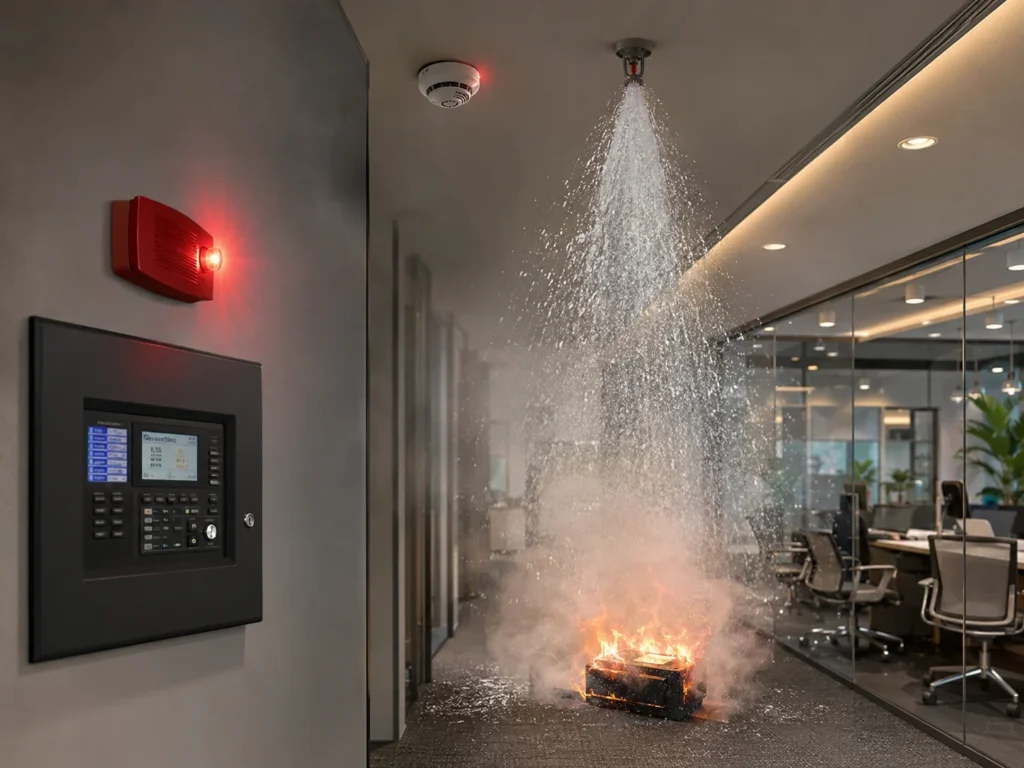
Building safety is not judged solely by its structural integrity during an earthquake or its durability over time. It is judged, first and foremost, by its ability to protect human life and property in a moment of crisis. Fire is one of the most unpredictable and destructive hazards for any structure.
In the modern construction industry, fire protection is not just a bureaucratic obligation or a checklist for issuing a permit. It is a holistic design philosophy. The materials we choose and the systems we install in our projects represent the first and last line of defense, buying valuable time for building evacuation and fire department intervention.
Passive vs. Active Fire Protection: The Dual Shield
To understand how a building is fortified, we must divide fire protection into two main, yet interdependent, pillars: Passive and Active.
1. Passive Fire Protection: Structural Resistance
Passive fire protection is integrated into the very structure of the building during the construction phase. It requires no activation (e.g., electricity or water supply) to function. Its main goals are:
- Containing the fire at its point of origin (fire compartmentation).
- Preventing the collapse of the building’s structural frame.
- Ensuring safe escape routes for occupants.
2. Active Fire Protection: Immediate Response
These are the technological systems installed in the building that “wake up” as soon as they detect smoke or high temperatures. Their goal is early warning, containment, and, if possible, extinguishing the fire before it grows out of control.
Passive Fire Protection: Materials That Buy Time
Choosing the right construction materials is the A to Z of creating a “fireproof” environment. Let’s look at the most important materials and their applications:
Structural Frame and Fireproofing
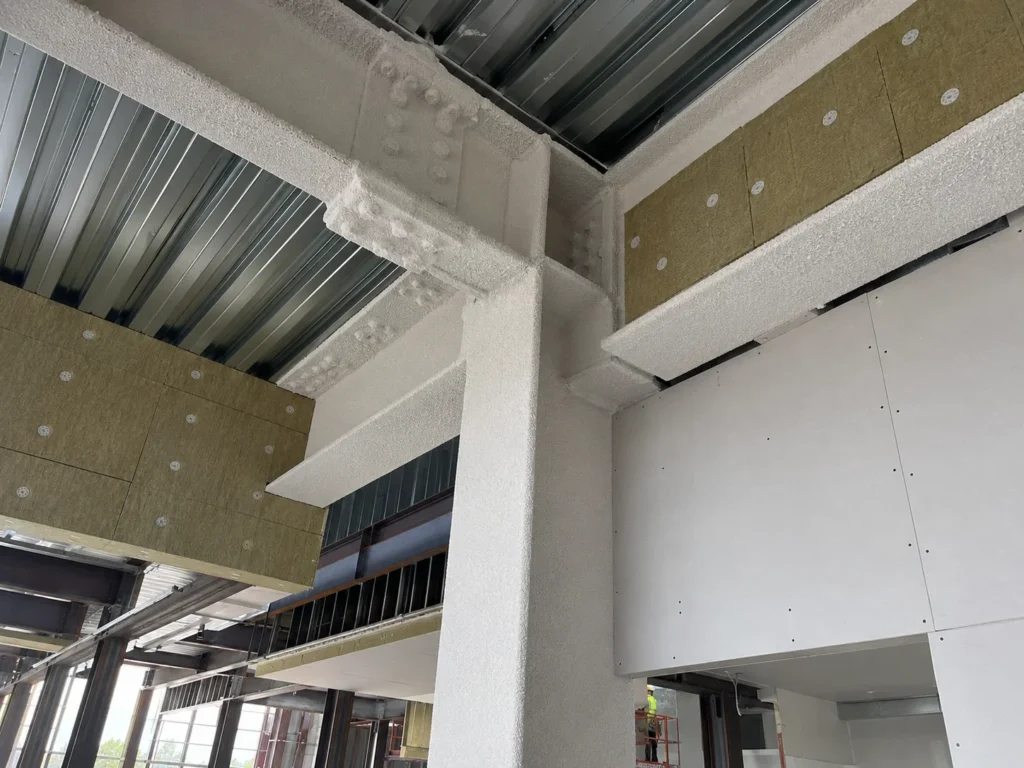
Concrete (reinforced concrete) has excellent natural fire resistance, but under extreme temperatures for prolonged periods, the steel inside it risks losing its strength. Similarly, steel structures are highly vulnerable to high temperatures, as they bend easily. To protect them, we use:
- Intumescent paints: Special coatings that, when exposed to heat, expand to create a thick, insulating layer of foam around steel beams, delaying the heating of the metal for 30, 60, or 120 minutes.
- Fire-rated boards (cement boards/gypsum boards): Coverings that “clad” columns and beams, offering high thermal resistance.
Insulation Materials and Masonry
The choice of insulation (external thermal insulation composite systems, roof insulation) plays a critical role in preventing fire from spreading through the building’s facade.
- Rockwool: The ultimate natural fire protection material. Produced by melting volcanic rock, it is completely non-combustible (Class A1) and can withstand temperatures exceeding 1,000°C without melting or emitting toxic gases.
- Fire-Rated Gypsum Boards (Type F): These contain glass fibers and other additives in their core, increasing their cohesion under the impact of fire. They are used to create partition walls that act as barriers.
Fire-Rated Doors and Glazing
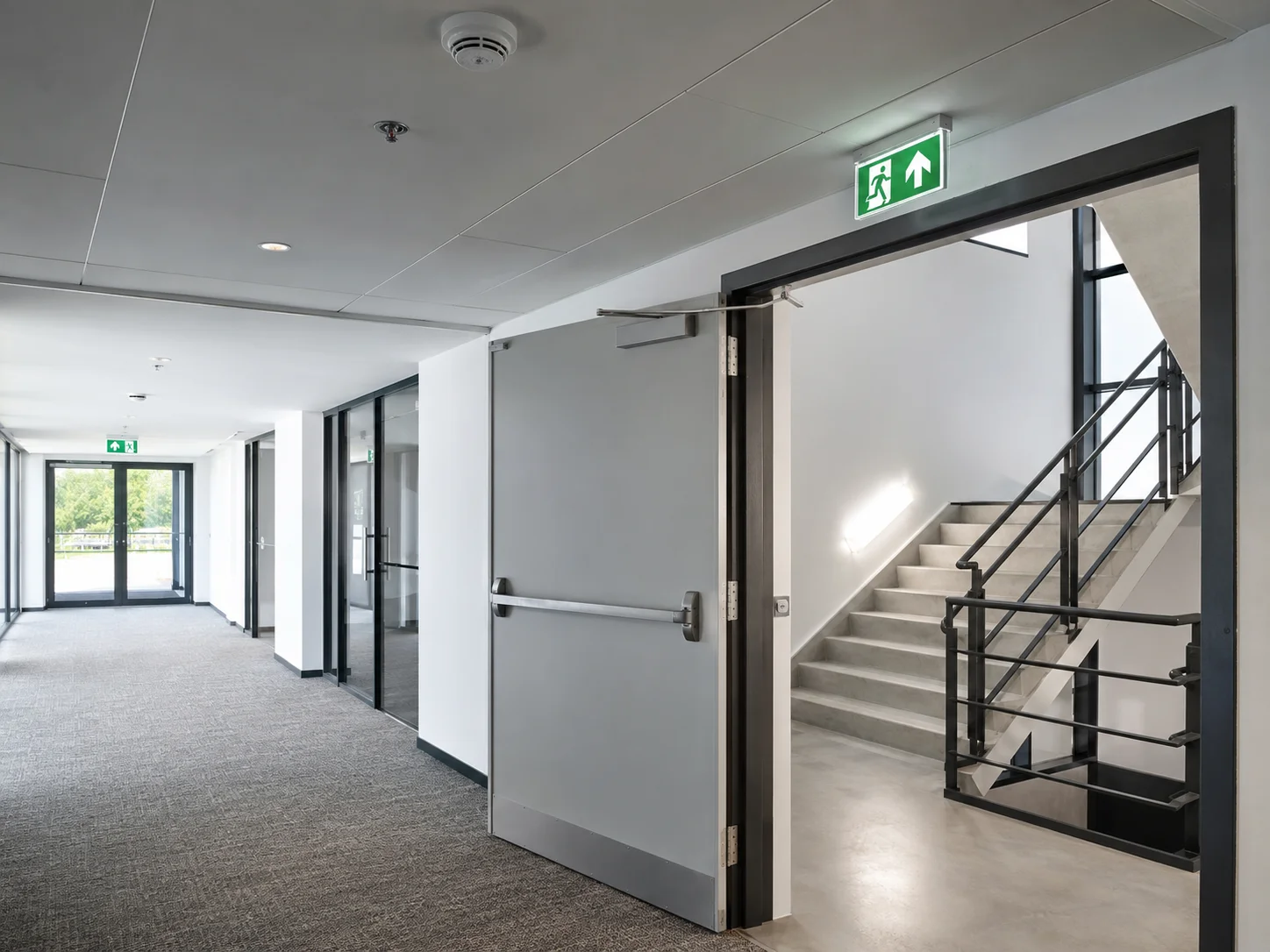
Fire doors are essential in stairwells and mechanical rooms. They feature special intumescent seals around their perimeter, which expand and seal completely when exposed to heat, blocking the passage of deadly smoke. Similarly, fire-rated glass (double or triple-glazed with a special gel in between) holds back thermal radiation.
Important: The effectiveness of passive systems is measured in minutes (e.g., REI 60, REI 120). The “120” means that the structural element maintains its structural adequacy (R), integrity (E), and thermal insulation (I) for two full hours inside the fire.
Active Fire Protection: Systems That Act Instantly
If passive materials are the building’s “armor,” active systems are its “reflexes.” A modern construction integrates high-tech solutions to address danger.
1. Addressable Fire Alarm Systems
Older systems simply indicated that there was a fire on a certain floor. Modern addressable systems provide the exact location of the fire source in real-time (e.g., “Detector 4, Office 202, 2nd floor”). This allows the security team or the fire department to act target-specifically without wasting time.
2. Automatic Sprinkler Systems
Sprinklers remain the most effective method of suppression. Each head operates independently: a glass bulb filled with a special liquid breaks when the temperature at that specific point exceeds a threshold (usually 68°C), releasing water. This means the system does not flood the entire building, but only the area on fire.
3. Clean Agent Suppression Systems
In areas with sensitive equipment, such as data centers, servers, or archives, water would cause more destruction than the fire itself. In these spaces, special gas systems are installed (e.g., FM-200, Inergen, or CO2). These gases reduce oxygen or absorb heat, extinguishing the fire in seconds without leaving residues or damaging electronic circuits.
4. Smoke Control Systems
In most fires, the main cause of loss of life is not the flames, but the inhalation of toxic smoke. These systems include:
- Automated windows/roof skylights that open to vent smoke outdoors.
- Positive pressure fans in stairwells, which push clean air into the stairs, preventing smoke from entering evacuation routes.
The Importance of Proper Design and Specialized Construction
The availability of good materials on the market does not alone guarantee a safe building. The key lies in a holistic fire protection study and, above all, correct installation on the construction site.
The Problem of “Blind Spots”
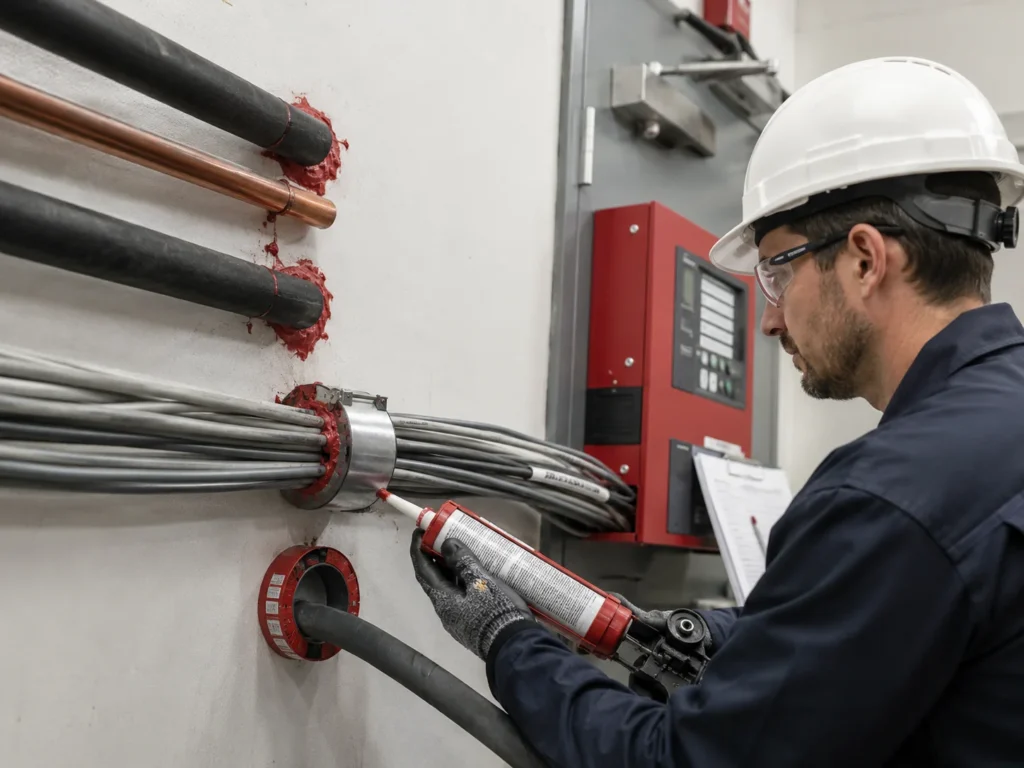
A common mistake in construction is neglecting the penetration points where pipes and cables pass through (utility penetrations). If a hole is drilled into a fire-rated wall for cables to pass through and the gap is not sealed with special fire-stopping materials (fire-rated sealants, pillows, or collars), then that wall loses its property. Fire and smoke will pass into the adjacent space within minutes.
Maintenance: The Forgotten Detail
A fire protection system is only as good as its last maintenance. Sprinkler network pumps, fire alarm panel batteries, and self-closing mechanisms on fire doors must be checked periodically in accordance with regulations.
Investing in Safety: A Choice with Zero Risk
Many believe that the strict implementation of advanced fire protection systems unjustifiably increases the construction cost of a building. However, reality proves otherwise:
- Life Protection: Human life is priceless. Knowing that a building has been designed to protect its occupants offers unparalleled peace of mind.
- Reduced Insurance Premiums: Insurance companies offer significantly lower premiums for buildings that feature certified passive and active systems (e.g., automatic sprinkler systems).
- Property Added Value: In the modern real estate market, safety and resilience are key buying or renting criteria, especially for commercial buildings, hotels, and office spaces.
Conclusion
In our construction company, we view fire protection as an integral part of our projects’ quality. From using top-quality rockwool in our insulation to installing the most modern fire detection systems, our goal is to deliver buildings that are not just beautiful and functional, but true fortresses of safety for you and your loved ones.
Prevention and proper planning are not costs; they are the most essential investment for the future.