

5 Factors That Determine a New-Build’s Value
Buying a new-build often feels like the “safe” choice — but real value isn’t defined only by the year of construction or the aesthetics. This guide distills the five most critical factors that shape the price, livability, and resale value of a new-build in Thessaloniki. Use it as a pre-offer checklist.
1) Location: access, micro-area, and momentum
“Location” isn’t a cliché; it’s a sum of parts:
- Access & connectivity: travel times to work/study hubs, public transport stops, road junctions.
- Micro-location: noise, street slope, sun/shade, site frontage, proximity to green space or civic uses.
- Urban evolution: upcoming infrastructure (roads, stations, schools), planning trends, vacant plots.
- Neighborhood & services: supermarkets, pharmacies, sports facilities, parking supply.
Tip: Check the area at three times (morning/afternoon/evening) and on different days. Traffic and lighting change the feel dramatically.
2) Developer & materials: quality that endures
The developer’s track record and the technical spec directly influence value.
- Transparency: ask for a detailed spec (concrete, insulation, plumbing, electrics, windows/doors).
- Materials & brands: ETICS/insulation specs; window profiles/glazing; flooring; plumbing (pipes, manifolds); automation.
- Warranties & after-sales: written warranties for materials/works; defect-handling process.
- Construction details: roof/balcony waterproofing, expansion joints, inter-apartment sound insulation.
Red flags: vague specs, generic phrases (“quality materials”), poor documentation of energy solutions.
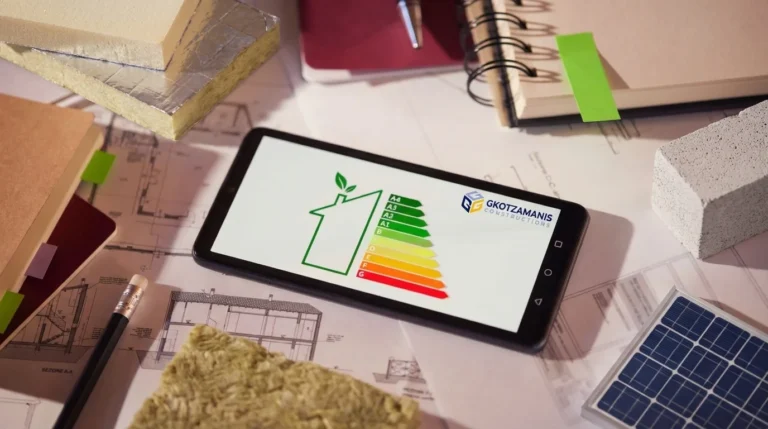
3) Energy class: savings today, value tomorrow
Energy performance isn’t just about bills — it adds a premium to resale.
- Energy Performance Certificate (EPC/ΠΕΑ): request a draft/class estimate with documentation.
- Envelope: insulation type/thickness, thermal-bridge treatment, low U-value frames, triple glazing where exposed to noise/sun.
- Systems: heat pump, underfloor heating, fan coils, MVHR (mechanical ventilation with heat recovery) on higher-performance projects.
- Smart control: zoned thermostats, remote control, efficiency profiles.
- Solar contribution: readiness for photovoltaics/net metering where feasible.
Rule of thumb: Higher class → better comfort & resale. Paying a premium can be worth it if the jump (e.g., A → A+) is backed by tangible savings.
4) Layout & “working” square meters
Square meters matter only when they perform.
- Flow: logical entry, clear circulation axes, minimal corridor waste.
- Privacy & zoning: bedrooms separated from living/kitchen; bathrooms near bedrooms.
- Storage: adequate closets/storage; practical kitchen cabinetry.
- Balconies: ≥ 1.60 m depth for real use; consider orientation and wind shielding.
- Value-boosting features: parking (especially in tight areas), storage room, elevator, EV-charging readiness.
5) Building infrastructure: shared elements that matter
Value isn’t only inside the apartment.
- Entrance & common areas: lighting, finishes, anti-slip flooring, step-free/accessible entries, CCTV with proper signage.
- Elevator: new-generation, low energy use, certifications, service plan.
- Envelope insulation/acoustics: execution quality on façades/roof.
- Waste, bicycle storage, courier lockers: small perks that raise daily comfort.
- Building regulations (by-laws): govern uses, pets, short-term lets—directly affecting the living experience.
Practical How-To: Evaluate a New-Build in 5 Steps
- Collect documentation: technical spec, dimensioned floor plan, draft EPC, material samples.
- Area check: three time slots, note noise/traffic/parking, distances to key services.
- Technical inspection: your own engineer for envelope, insulation, damp, MEP.
- Layout assessment: functionality, storage, sunlight, cross-ventilation, usable m².
- Compare & decide: run a CMA (Comparative Market Analysis) with 3–5 comps in the same micro-area; weigh energy class, value-add features (parking/storage), and building infrastructure.
Pro tip: If two homes are otherwise equal, choose the one with the better envelope/energy system — it pays off in bills and resale.
Pre-Offer Summary Checklist
- Clear view of micro-location and upcoming projects
- Full technical spec with brands and performance data
- Draft/justification of energy class and systems
- Usable m² verified from a dimensioned plan
- Parking & storage recorded on title
- Building regulations available
- CMA with 3–5 local comps
- Independent engineer’s check before signing