10 Ideas That Elevate Any Home so that it looks like “high-end”
Before you start: 5 terms in 30 seconds
- Kelvin (K): how “warm” or “cool” the light is. Living room/bedroom: 2700–3000K. Kitchen/home office: 3000–3500K.
- CRI: how accurately colors appear (0–100). Aim for CRI ≥90.
- Lumens: brightness (not Watts). More lumens = more light.
- Dimming: adjusting light output. Mind bulb–dimmer compatibility.
- IP: resistance to water/dust. Bathrooms/outdoors: check the zone and minimum IP (e.g., IP44).
Build “layers” of light
What it is: Combine three levels—Ambient (general), Task (work), Accent (highlighting).
Why: The room gains depth and adapts to use with the premium lighting.
How:
- Ambient: ceiling fixture or discreet tracks/linear lights.
- Task: floor/table lamps; under-cabinet lighting in the kitchen.
- Accent: spots aimed at art/walls or LED lines in shelves.
Pick the right color temperature for a premium lighting (Kelvin)
- Warm (2700–3000K): living room, bedroom—relaxing.
- Neutral (3000–3500K): kitchen, office—clean & functional.
Tip: If possible, choose dim-to-warm (gets warmer as you dim).
Want “vivid” colors? Choose CRI ≥90
Why: Wood, fabrics, and skin tones look natural.
Where: living room, kitchen (worktops/food), spaces with art.
Add dimming & 2–3 “scenes”
What: Preset levels (e.g., “Movie,” “Dinner,” “Everyday”).
Benefits: right atmosphere + energy savings.
Watch out: ensure bulb and switch are dimming-compatible.
Wall washing
What: Uniform light across the wall.
Why: Makes the room feel larger and “cleaner.”
How: spots or linear lights 20–40 cm (8–16 in) from the wall, angled toward the surface.
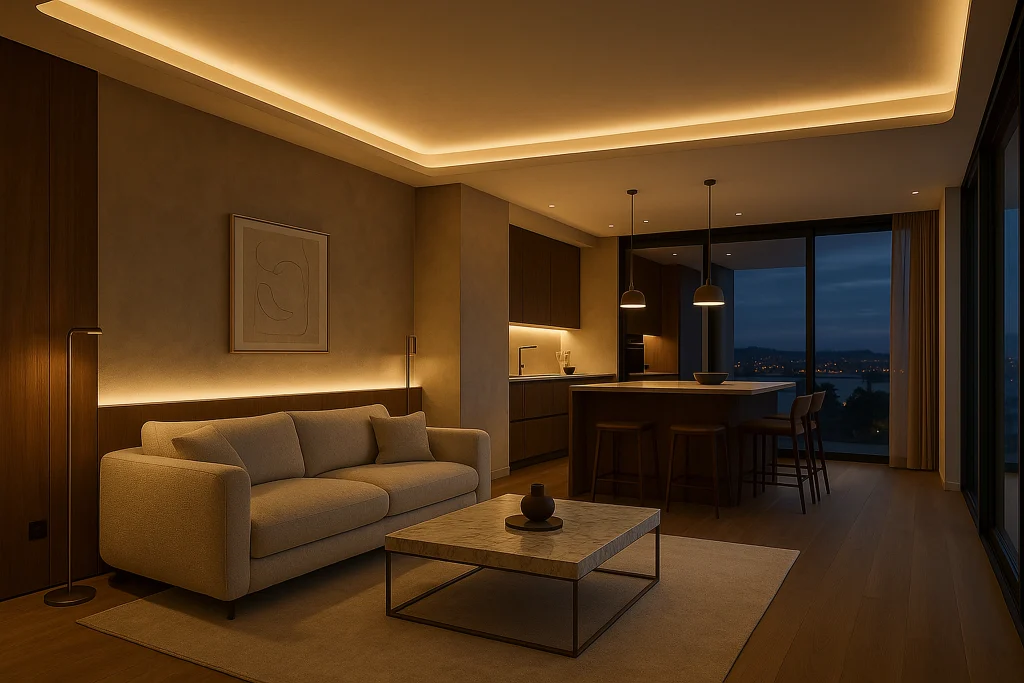
Concealed/indirect light = premium without glare
Where: ceiling coves, under counters, cabinet toe-kicks.
How: continuous LED lines with a diffuser (no visible “dots”).
Kitchen: crisp task light on the worktop
- Under cabinets: continuous line 3000–3500K, CRI ≥90.
- Island: 2–3 pendants plus general ceiling light.
Mistake to avoid: only pendants over the island with no light on the counter.
Bathroom: light the face, not from above
- Mirror: vertical/perimeter fixtures at eye level to avoid shadows.
- Zones/IP: near water, ensure IP44+.
Common mistake: relying only on ceiling spots—creates harsh, all-over shadows.
Bedroom: calm, warm light + independent points
- 2700K, sconces on each side of the bed, switches by the headboard.
- Subtle wall washing at the headboard “softens” the room
Outdoors: atmosphere, not floodlights
- 2700K, low levels, light for paths/steps (step lights), careful uplights on plants with glare control.
- Timers/sensors = comfort & savings.
Room-by-room recipes (copy-paste guide)
Living room: 1 ambient + 1–2 task lamps + 1 accent on wall/art, 2700–3000K, CRI ≥90, 2 scenes.
Kitchen: general ceiling light + continuous under-cabinet line, 3000–3500K, CRI ≥90.
Bathroom: general + mirror at face height, 3000–3500K, correct IP.
Bedroom: 2700K, sconces per side, subtle concealed light.
Balcony:2700K, step/bollard lights low, timer.
Quick yes/no
Yes: 3 light layers, CRI ≥90, dimming, concealed/wall lighting.
No: a single central fixture, very “cool” light in relaxing areas, bare LEDs that glare, spots without a plan.